Support Around You.
LifeGlider's frame and waist support help suitable users feel supported while standing and taking steps.
 THE ORIGINAL WRAP-AROUND WALKER
People may speak to the person beside you or lean down to talk. Even with good intentions, it can leave you feeling overlooked.
Standing with LifeGlider brings you to the same level as friends. Talk directly, share a laugh and enjoy being in the moment together.
Our customers tell us they sometimes put off walking because they feel unsafe or unsteady. LifeGlider is designed to support people who can walk a little, helping them spend more time on their feet.
People who use a wheelchair and can also walk are called ambulatory wheelchair users. Some also call themselves part-time wheelchair users. LifeGlider offers another way to move when you want to walk, with your wheelchair there when you need it.
Lana explains why being eye to eye matters ↓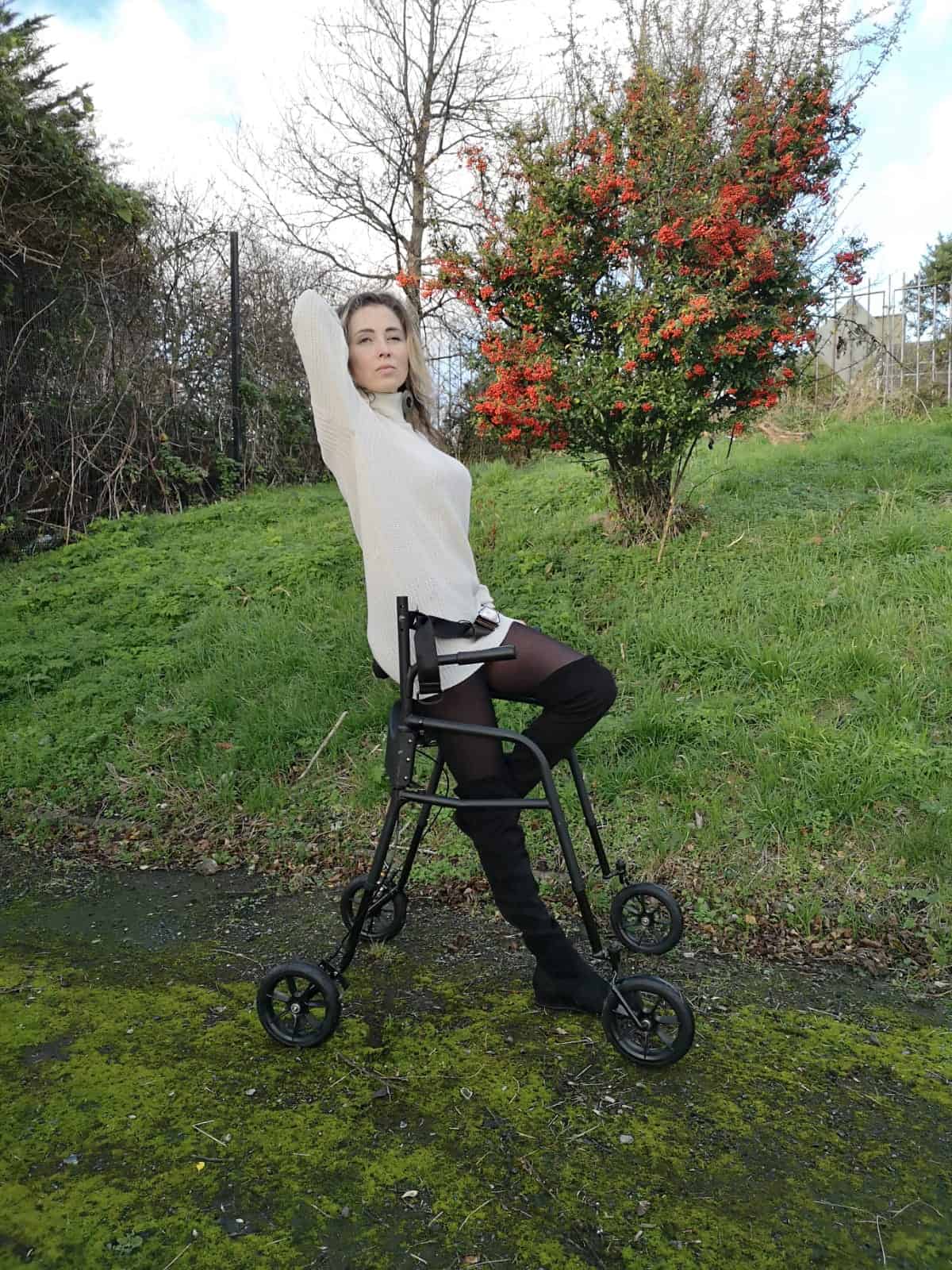
Lana told us people sometimes spoke to her companion instead of her when she used her wheelchair. Others leaned down to be polite, but it left her feeling small.
Learning to walk with LifeGlider took time and practice. For Lana, standing alongside others changed how conversations felt. People spoke directly to her, at eye level. She felt seen.
Meet Lana and read her story ↗Lana's personal experience, as shared with Mobility UK. Progress is individual.
LifeGlider's frame and waist support help suitable users feel supported while standing and taking steps.
A little regular walking may help you work towards strength, confidence and everyday mobility goals, at your own pace.
Stand with friends, move around the kitchen or enjoy a short walk. Start with something that matters to you.
LifeGlider is for people who can bear weight and take steps. How much you walk, and whether your wheelchair use changes, depends on your condition and progress.
Being able to stand or walk a short distance does not mean someone can walk safely, comfortably or reliably all day. Pain, fatigue, balance and symptoms can fluctuate. The same person may walk at home and use a wheelchair outside, or need different support from one day to the next.
Ambulatory wheelchair users can face disbelief or accusations that they do not need their chair when others see them stand. That misunderstanding can leave people feeling judged, excluded or reluctant to move in public. Standing up does not invalidate someone's disability or their need for a wheelchair.
Listen to the person, speak directly to them and respect the mobility aid they choose. LifeGlider and a wheelchair can both have a place in the same person's everyday life.
Cerebral Palsy Scotland: Mhairi's account of ambulatory wheelchair use and stigma ↗LifeGlider provides wrap-around walking support for people who can bear weight and take steps. Discuss the person's mobility, intended activities, dimensions and support needs when considering equipment.
The research below covers physical activity, walking rehabilitation and supported standing. It provides clinical context. It does not establish LifeGlider-specific outcomes or show that all ambulatory wheelchair users will benefit in the same way.
For an NHS quotation or supplier-account enquiry, contact hello@lifeglider.org with the organisation, size and quantity, delivery postcode and procurement requirements. We can provide company details and payment terms with your quotation.
Around 1.2 million
This is a long-standing UK wheelchair-user estimate repeated in NHS information, including a 2024 NHS trust leaflet. It is not a new population count for 2026.
CNTW NHS Foundation Trust: wheelchair users and exercise (2024 leaflet)We have not identified a robust UK-wide estimate of the proportion who can also walk. We therefore do not assign a percentage to ambulatory wheelchair users here.
The often-quoted description that around two-thirds are regular wheelchair users answers a different question. Regular wheelchair use does not establish whether someone can stand or walk.
A government-commissioned 2022 report highlighted gaps and uncertainty in wheelchair-user data, including the gap between NHS service registrations and wider estimates.
Department for Transport: Reference wheelchair research, full report (2022)These sources concern physical activity, rehabilitation or supported standing. They are relevant background, but none of the studies below tested LifeGlider.
UK Chief Medical Officers' guidance identifies benefits of physical activity for disabled adults including muscle strength, mobility, balance, independence and mental wellbeing. The NHS also explains that wheelchair users can be active in ways that suit their abilities.
Standing and walking are not the only forms of activity. Wheeling, seated exercise and other suitable activities can contribute too.
UK Chief Medical Officers: physical activity for disabled adults NHS: fitness advice for wheelchair users“Offer walking training to people after stroke who are able to walk, with or without assistance”
NICE NG236 recommends walking training to build endurance and walking speed after stroke. It also recommends repeated practice of everyday tasks, including sit-to-stand and walking, for lower-limb weakness.
Repeated practice is sometimes described informally as building muscle memory. The clinical emphasis here is on practising specific skills, not a promise that a device repairs nerves or reverses a condition. The recommendation concerns people after stroke and should not be applied automatically to every diagnosis.
NICE NG236: stroke rehabilitation, recommendations 1.13.20 and 1.13.21Paleg and Livingstone reviewed supported-standing programmes for adults with neurological conditions. The stronger evidence concerned joint range of motion and activity, mainly in stroke and spinal cord injury. Findings on bone density were mixed, and evidence for several other outcomes and populations was weaker.
The review covered standing equipment and programmes with different support arrangements. It does not show that any particular walking aid will produce the same results.
Paleg and Livingstone (2015): systematic review of supported standingThe SUMS trial compared a supported home standing-frame programme plus usual care with usual care alone in people with severe progressive multiple sclerosis.
Motor-function scores improved by an adjusted 4.7 points more in the standing group at 36 weeks. This was statistically significant, but below the 9-point difference the researchers had set in advance as clinically meaningful. Short-term musculoskeletal pain was reported more often in the standing group; no study-related serious adverse events were reported.
This was a specific standing-frame programme with physiotherapy input, not a LifeGlider trial or evidence that every wheelchair user should stand or walk more.
Freeman and colleagues (2019): the UK SUMS randomised trialNICE's neurological rehabilitation guidance supports an individual approach to fatigue: working towards the person's priorities, pacing, conserving energy and choosing appropriate activity within an overall plan.
Using your wheelchair to save energy can help you take part in the things you value. You do not need to prove how far you can walk or push through symptoms to justify using it.
NICE NG252: rehabilitation for chronic neurological disorders, fatigue managementIf you have ME/CFS or post-exertional malaise, increasing activity can worsen symptoms. NICE ME/CFS guidance advises working within individual energy limits and avoiding programmes that impose fixed increases in exercise.
If standing causes dizziness, significant pain, or you have weight-bearing restrictions, discuss appropriate activity with your clinical team. A walking aid is not a substitute for the extra support provided by a clinical standing frame.
These are considerations for choosing safe activities and rehabilitation, not a requirement to book a formal assessment before ordering LifeGlider.
NICE NG206: ME/CFS energy management and physical activityTalk to us about your mobility and watch LifeGlider in use.
Request your free video demonstration ↗Explore more real-life stories ↗