It Never Met The Need
The fit, handling, support or home environment may make a device impractical. The person still needs a workable solution.
 THE ORIGINAL WRAP-AROUND WALKER
EQUIPMENT PROVISION AND INDEPENDENCE
If your walking aid stays in the corner because it does not feel right for you, the important question is what would help you get moving. LifeGlider offers a different approach: support around your body, rather than a frame held only in front of you.
Explore the equipment, understand the difference and see whether it could fit your everyday life.
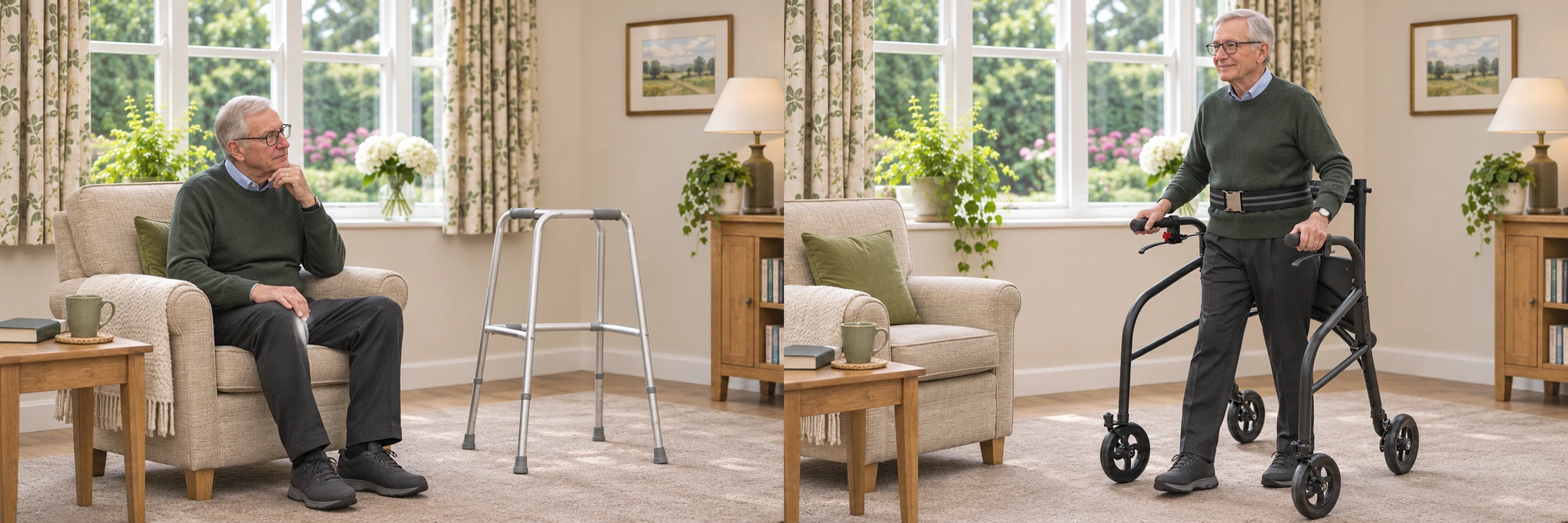
SUPPORT THAT WRAPS AROUND YOU
Standing to talk, moving around the kitchen or walking across the room can matter far more than simply having a piece of equipment delivered.
LifeGlider's wrap-around frame and waist support offer an alternative to conventional frames and rollators. A built-in perch is there when you want to rest. Explore how that support feels and whether it works for the things you want to do.
Illustrative scenes featuring a fictional person, not a customer testimonial or a measured before-and-after result. Suitability depends on the individual.
THREE DIFFERENT PROBLEMS
We need to know why equipment has been set aside before calling it a failed allocation.
The fit, handling, support or home environment may make a device impractical. The person still needs a workable solution.
A potentially useful device may go unused without clear instructions, practice, adjustment or follow-up.
Successful recovery or changed needs can leave good equipment idle. The next step is review and, where appropriate, return and reuse.
The first two issues reflect barriers identified in the UK-led review and NIHR summary [3, 4]. Returns are a separate service issue [1, 2].
WHAT THE RESEARCH ACTUALLY SHOWS
Published findings vary by device, population and definition. These European examples show why a headline percentage cannot describe every service or person.
ITALY · REGIONAL SERVICE USERS · 2016
There were 419 mobility-device recipients among 749 interview respondents.
The wider study also included hearing devices. These historical findings do not establish a current UK rate.
Regional Italian survey, not a UK rate or evidence that every abandoned device was badly allocated. Read the study summary [5] →
NETHERLANDS · MULTIPLE DEVICE TYPES · 2006
Dijcks and colleagues surveyed 2,272 respondents across 14 device categories, using samples selected in 2001 and 2003.
Fewer than 1% said they had never used the device. The authors emphasised that non-use varied by device category and was lower than some earlier accounts suggested.
Historical Dutch evidence, not current UK performance. These two charts describe different samples and should not be used to rank countries. Read the original abstract [6] ↗
THE COST TO THE PERSON
A device can be delivered while the person's walking goal remains out of reach. It matters whether they can use it for the movements and places that make up their day.
NIHR's account describes barriers including awkward equipment, inadequate information, delays, limited involvement in decisions and previous disappointment. These experiences can discourage use. [4]
The meaningful outcome is usable support and progress towards the person's goals, not simply an item delivered.
The impact will differ for each person. We do not assign a national cost or fall rate to unsuitable equipment.
The person may still be unable to practise walking or manage an activity independently. Ask what they hoped the aid would make possible.
Repeated attempts with something uncomfortable or difficult can be frustrating. Listen to the person's experience before assuming they are unwilling to try.
Review where equipment is stored and whether it obstructs an everyday route. Unneeded items should not make the home harder to move around.
A CATALOGUE IS A STARTING POINT
A UK-led synthesis of 40 papers identifies connected barriers involving design, services, information, confidence, support and society. The authors argue for personalised provision and creative problem-solving beyond pre-defined prescription lists. [3]
Mobility UK's view: a standard list should not become the limit of what a person is allowed to explore. Where the closest available item does not meet the need, there should be a clear route to consider alternatives.
The practical question is how easily clinicians can reach beyond standard stock when a person needs something different.
ASK ABOUT THE NON-STOCK ROUTE
Devon's published policy allows authorised non-stock items when catalogue stock does not meet the assessed need, and bespoke equipment when stock and non-stock options are insufficient. [7]
Local criteria and authorisation differ. This is an example of a route, not a guarantee of funding for LifeGlider.
THE COST OF ISSUING TWICE
Compare the whole provision pathway: the original device, repeat visits, a replacement and any collection or reprocessing. Count recoverable value where equipment can safely return to use.
| Cost or outcome | Poor match, then replacement | Suitable provision from the start |
|---|---|---|
| Equipment | Original purchase plus replacement | Suitable item and agreed adaptations |
| Staff and logistics | Additional review, transport or reprocessing may be needed | Plan fitting, training and review upfront |
| Patient's time | Waiting, repeated appointments and unmet goals | Focus on practical use and agreed goals |
| End of use | Recover, check and reuse where appropriate | The same return and reuse planning still matters |
THE EXTRA COST, EXPLAINED
These worked examples use illustrative round figures, not NHS tariffs or LifeGlider prices. Each assumes the same eventual suitable device costing £200. Routine initial service costs common to both routes are excluded.
EXAMPLE 1
An unsuitable £100 aid is replaced with a suitable £200 device. An extra review costs £50 and collection costs £20.
The purchase price was only part of the cost.
EXAMPLE 2
In the same example, the first aid is returned and has £40 of recoverable value for reuse. The review and collection costs remain.
Reuse reduces waste but does not remove every extra cost.
EXAMPLE 3
If ten people each follow the £170 additional-cost pathway in Example 1, the combined extra cost is:
A simple illustration of scale, not a measured service result or an assumed failure rate.
These examples do not put a cash value on lost mobility, distress or family time, or assume that LifeGlider avoids these costs. Matching equipment to the person remains the priority.
MAKE RETURNS PART OF THE SERVICE
Keeping a useful device in a cupboard after its purpose has ended is different from receiving an unsuitable device. Both deserve a clear response.
A REPORTED NHS RESULT
4,563The Health Board reported £72,000 saved for the preceding year in its 22 April 2026 update. It also described reused specialist frames helping to avoid discharge delays during a supply shortage. [1]
Local scheme results. They do not establish a national waste total or a poor-allocation rate.
A MODELLED REUSE OPPORTUNITY
£46,000WRAP estimated this saving if two in five issued walking aids were returned for reuse. This is a modelled opportunity, not a measured saving at every trust or proof that the other three in five are unused. [8]
WRAP's 2023 campaign estimate. Keep it separate from the Cardiff result.
A June 2026 parliamentary answer says the Department had not estimated replacement costs for loaned equipment that was lost, damaged beyond repair or not returned. It identifies the lending NHS body as responsible for pursuing returns. [2]
That reporting gap is a reason to collect better local data, rather than invent a UK total.
Loaned equipment is not yours to sell or discard. Follow the supplier's instructions; returned items need appropriate checks before reuse. [9]
Find information about walking-aid returns ↗DOES THIS SOUND FAMILIAR?
If a conventional aid is not meeting your needs, or those of someone you love, explore a different approach. We can demonstrate LifeGlider's wrap-around support and discuss practical questions about your mobility and home.
For professional teams, we welcome discussion about appropriate alternatives, training, follow-up and responsible loan pathways. Suitability depends on the individual.
Have experience of unsuitable equipment, difficult returns or a service that got it right? Share your experience →
SOURCES AND SCOPE
Reviewed 5 November 2026. Older studies are dated clearly. No source below tested whether LifeGlider reduces equipment abandonment or guarantees savings. No endorsement is implied.