
Estimated annual NHS cost of hip fractures reported by the National Hip Fracture Database.
NHFD 2026 report [3]FOR PHYSIOTHERAPISTS, OTs AND GPs
Prevention Is
Better Than Cure.
When a person is at risk of falling and a traditional walking aid is not meeting their needs, the next step should be a better option for that person.
Explore the human and financial case for earlier, suitable walking support, and where LifeGlider could fit into your patient's mobility plan.
A PREVENTABLE BURDEN DESERVES ATTENTION
A Fall Can Change A Life.
The Impact Reaches Across Services.
Hospital care is only part of the picture. Recovery can also involve rehabilitation, support at home and help from family or friends.
Hospital beds occupied by people receiving care after a hip fracture, according to the same report.
England, Wales, Jersey and Northern Ireland [3]Projected UK social care costs in the first 120 days after hip fracture, including formal and informal care.
2026 prospective cohort study [4]Who Is Being Admitted?
Emergency falls admissions, England, 2024/25, age 65+.
65%aged 80+
Age 80+143,874
Age 65 to 7977,726
FALLS ARE COMMON
Most Falls Never Become A Hospital Statistic.
1 in 3
people aged 65+ fall at least once a year.
1 in 2
people aged 80+ fall at least once a year.
Approximate estimates in OHID's All Our Health guidance [2], updated 2022. These are annual fall estimates, not admission rates.
The priority is practical: identify what is making walking unsafe, address the person's risks and provide support they can actually use.
MORE THAN AN INJURY
Fear Can Take Away The Walking A Person Still Has.
OHID describes how concern about falling can reduce activity. Less activity can lead to weakness and poorer balance, making further falls more likely. [2]
The goal is more than avoiding a hospital admission. It is helping a person keep moving, take part and retain independence.
Equipment is one part of an individual plan, alongside appropriate exercise, medication review, bone health and the home environment. NICE recommends addressing each person's identified risks. [5]
The Fall
A fracture or other injury can lead to urgent care and a loss of mobility.
The Recovery
Treatment, rehabilitation and support after discharge can continue long after the initial injury.
The Everyday Consequences
Concern about falling again can change ordinary decisions, from walking to the kitchen to leaving home.
THE FINANCIAL CASE FOR PREVENTION
Compare The Equipment Cost With The Cost Of An Admission.
Limited budgets make the timing of investment matter. If suitable support prevents an injury requiring hospital care, the avoided cost could exceed the equipment purchase price.
Published Costs, With The Scope Kept Clear.
| Model input | Cost |
|---|---|
| Inpatient stay with hip fracture | £11,582 |
| Inpatient stay for a non-hip-fracture injury | £10,281 |
These are modelled inpatient costs, based on earlier PHE estimates uprated for the NICE model. They are not a current operation-only tariff. The second figure is not a specific broken-leg repair price. Read the model [6].
Hospital treatment includes more than surgery. Adding an operation fee or extra hospital days to an admission cost can count the same care twice. Use local costs where available.
BUILD A LOCAL COST EXAMPLE
What Would An Avoided Admission Be Worth?
Change the assumptions for an individual purchase or a service-owned loan pool. The number of admissions avoided is an assumption you enter, not a predicted LifeGlider outcome.
Start With The Person
The potential benefit depends on suitability, safe use and whether the equipment changes that person's outcomes.
Cost The Whole Service
A loan pool can serve successive users. Plan for cleaning, checks, repairs, training, delivery and retrieval rather than assuming free reuse.
Measure The Difference
Record falls, injuries, near falls, walking goals, confidence and support needs. Evaluate outcomes alongside total provision costs.
WHEN A STANDARD AID IS NOT WORKING
Look Beyond What Is Already In The Equipment Cupboard.
A person may be able to bear weight and take steps, yet find a stick, crutches or a conventional frame difficult to use. Hand and arm discomfort, posture, coordination and confidence can all be part of the conversation.
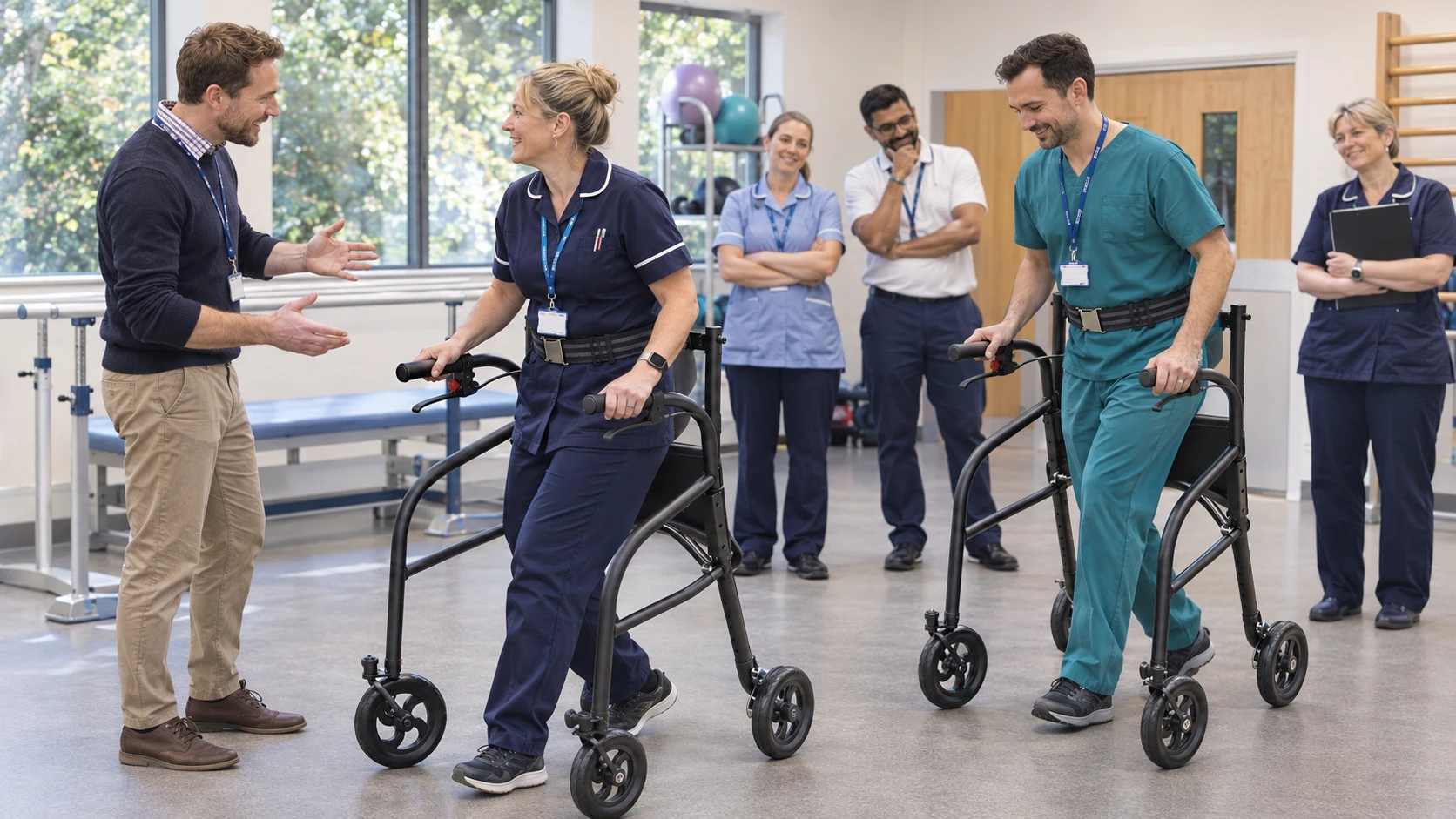
LifeGlider provides a wrap-around frame, waist support and a built-in perching seat. A practical demonstration lets your team explore how that different support works for a particular person.
- Can the person bear weight and step within their current clinical instructions?
- Does the size, harness fit and support work for their body and walking pattern?
- Can they enter, fasten, brake, turn and exit, with their planned level of help?
- Does it work around their home, toilet, doors and everyday activities?
After surgery or fracture, follow the treating team's weight-bearing restrictions and precautions. LifeGlider should not be assumed to replace prescribed non-weight-bearing equipment.
A REAL PERSON'S EXPERIENCE
Val Wanted A Different Way To Stand And Step.
She describes polio, later injuries and difficulties using conventional aids. With LifeGlider she noticed a more upright posture and a more natural step, while continuing to face fatigue and practical challenges.
Read Val's experience so far →An individual account, not a clinical trial or a fall-prevention rate.
MAKE THE NEXT STEP PRACTICAL
For Physios, OTs, GPs And Equipment Services.
Consider LifeGlider where a patient's existing walking support is not meeting their needs. Bring the person, their goals and their environment into the decision.
See The Equipment
Explore adjustment, harness positioning, braking, entry, exit and folding in a professional demonstration.
Arrange a team session →Build A Provision Case
Ask Mobility UK for a quotation, product information and help with your service's supplier or purchase-order process.
Request a quotation →Plan A Loan Pathway
Discuss a service-owned pool or temporary recovery use. Agree suitable users, handover, training and support arrangements.
Discuss a loan pool →Where the evidence stands: the national figures establish the burden of falls. They do not prove a LifeGlider fall-reduction rate or return on investment. NICE identifies a need for better evidence on assistive technologies for falls prevention [8]. Individual suitability and product-specific outcomes remain essential.
MOBILITY UK'S MISSION
Safer Movement.
More Confidence. More Independence.
We are on a mission to widen access to LifeGlider and other suitable mobility products, with the aim of reducing accidents, injuries and deaths, preserving independence and making better use of NHS resources.
That means helping professionals explore options for people whose needs are not met by traditional aids, providing practical demonstrations and training, and building evidence about the difference equipment makes.
REPEATED FALLS AND EVERYDAY MOBILITY
What Happens While People Walk, Stand Or Use Walking Aids?
Explore independent studies of repeated falls during daily activities, including video analysis of falls involving wheeled walkers.
Explore the studiesShare your experience or recommend research →SUITABLE SUPPORT, RESPONSIBLE SPENDING
What If The Equipment Provided Goes Unused?
Explore the cost of poor matching, the effect on independence and why straightforward returns and reuse matter.
The cost of equipment that goes unused →CHECK THE EVIDENCE
Named Sources. Clear Dates. Open Reports.
Sources are cited for their data and guidance. These organisations do not endorse Mobility UK or LifeGlider. Evidence reviewed 5 November 2026.
[1] Emergency Falls Admissions
England, 2024/25. Age 65+: 221,600 admissions; age 65 to 79: 77,726; age 80+: 143,874.
Open the public health data ↗[2] Falls And Their Consequences
Approximate annual prevalence, fear of falling, reduced activity and approaches to prevention.
Read the guidance ↗[3] Hip Fracture's Hospital Burden
2026 annual report: estimated NHS cost and bed occupancy. Coverage: England, Wales, Jersey and Northern Ireland.
Open the audit report ↗[4] Social Care After Hip Fracture
Prospective observational cohort study. Projected UK cost in the first 120 days includes formal and informal care, not just NHS expenditure.
Read the study ↗[5] Individual Falls Prevention
NG249 recommendations: assess relevant risks and tailor interventions to the individual.
Read the recommendations ↗[6] Hospital Cost Inputs
NG249 economic model, table HE005, page 13. Model estimates, not a current local tariff.
Open the cost report (PDF) ↗[7] Equipment Comparison
£2,995 including VAT, checked 5 November 2026. Reference purchase price only; use an actual quotation for service planning.
Check sizes and current pricing →[8] Assistive Technology Evidence
NG249 evidence review F1 identifies insufficient high-quality evidence to recommend assistive technologies generally for preventing falls.
Read the evidence review (PDF) ↗Why do we not quote a UK percentage of falls caused by walking aids?
We have not verified a national dataset that measures how many falls were caused by sticks, frames or crutches. Using an aid during a fall does not establish that the aid caused it. We do not infer a percentage or a LifeGlider benefit from unrelated statistics.
Does this establish that LifeGlider saves the NHS money?
It shows the cost comparison if comparable admissions are prevented. A claim about actual LifeGlider savings needs product-specific evidence on outcomes and total provision costs. Reduced demand may release capacity without producing an equivalent cash saving.