
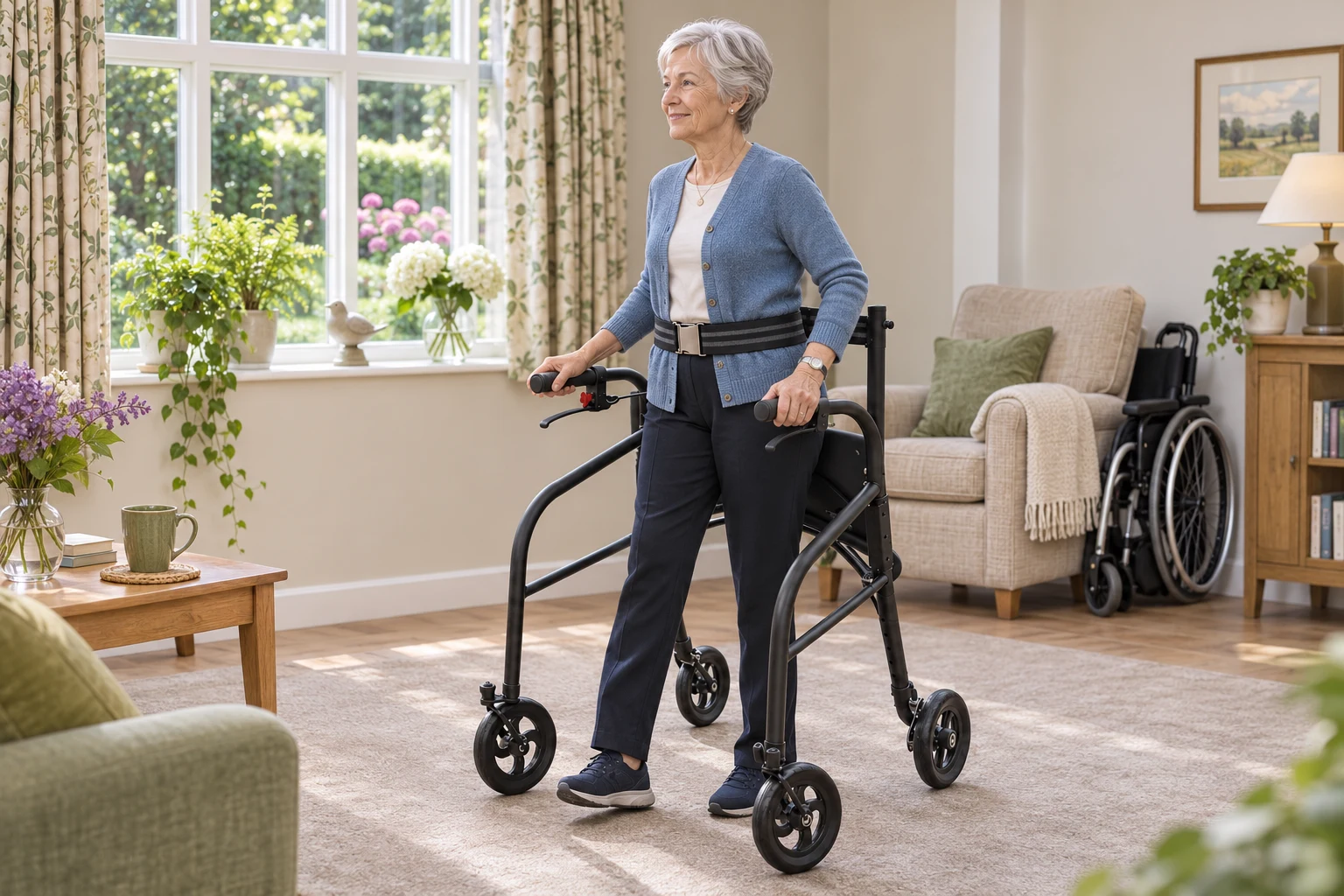
Val's mobility difficulties come from several experiences across her life, rather than one illness alone. She had polio almost 70 years ago, affecting her right leg and the muscles at the front of her thigh. She also describes poor experiences of childhood surgery and nursing, which she says contributed to further muscle wastage below the knee, foot drop and longstanding hip problems. Further surgery and changes in leg length have added to the difficulties over time.
A later injury added another major challenge. In 2012, Val broke the affected hip. She says the condition of the bone meant it could not be repaired. Even before that injury, she was finding walking difficult, using a crutch in the back garden and a mobility scooter or wheelchair for longer distances outside her home.
She describes herself now as a full-time wheelchair user. She has been trying to relearn walking since that hip injury, continuing physiotherapy while finding that rehabilitation support for her particular circumstances has been limited.
"This is the eighth time in my life I have had to relearn walking. I want to succeed."
Val was looking for support that felt different from crutches, walking frames and rollators. She found that crutches brought her shoulders upwards, while other walking aids made it difficult to find a natural standing position and gait. The possibility of hands-free support also appealed because she was trying to avoid a shoulder operation. In earlier correspondence, she explained that pain in her left arm and shoulder also made propelling her wheelchair difficult, even during a trip around a supermarket.
During a home demonstration with Ewan, she tried a Small LifeGlider around her kitchen. What stood out was the change she felt in her posture and the way her weaker leg moved.
"I was impressed on trying the life glider that I immediately stood up, my neck lengthening and shoulders dropping."
As she began to walk, Val noticed that her right leg followed through more naturally. She felt she did not have to lift her hip in the same way to take a stride. In her earlier emails, she described feeling more upright and balanced, bringing that leg forwards without swinging it out and limping less.
These changes matter to Val, but her account is also honest about the practical difficulties. Using LifeGlider is tiring for her. She began with a few minutes a day, as advised, and says progress has been slower than she would like. She continues exercises for both her weaker and stronger leg.
Her footwear is important. Because she needs a shoe build-up to accommodate the difference in leg length, she says she can only use LifeGlider with her correcting footwear. She also finds that its footprint can make manoeuvring in a small toilet difficult, and that clipping in and out takes time. Finding a way to fasten the belt one-handed remains another practical question for her.
Val sees promise in what LifeGlider could help her do around the house, while wanting more practical input to help her make the most of it. Her story is about finding a more natural way to stand and step, alongside the effort and support that her own circumstances require.
"It holds so much promise and I am unable to make the most of it."
This is Val's experience so far. She is still working towards the walking she wants to achieve, and has asked Mobility UK for further support. Her account describes both the difference she felt and the challenges she continues to face.
Based on Val's own emails to Mobility UK and Ewan. This is her personal experience, including ongoing difficulties and her request for more support.